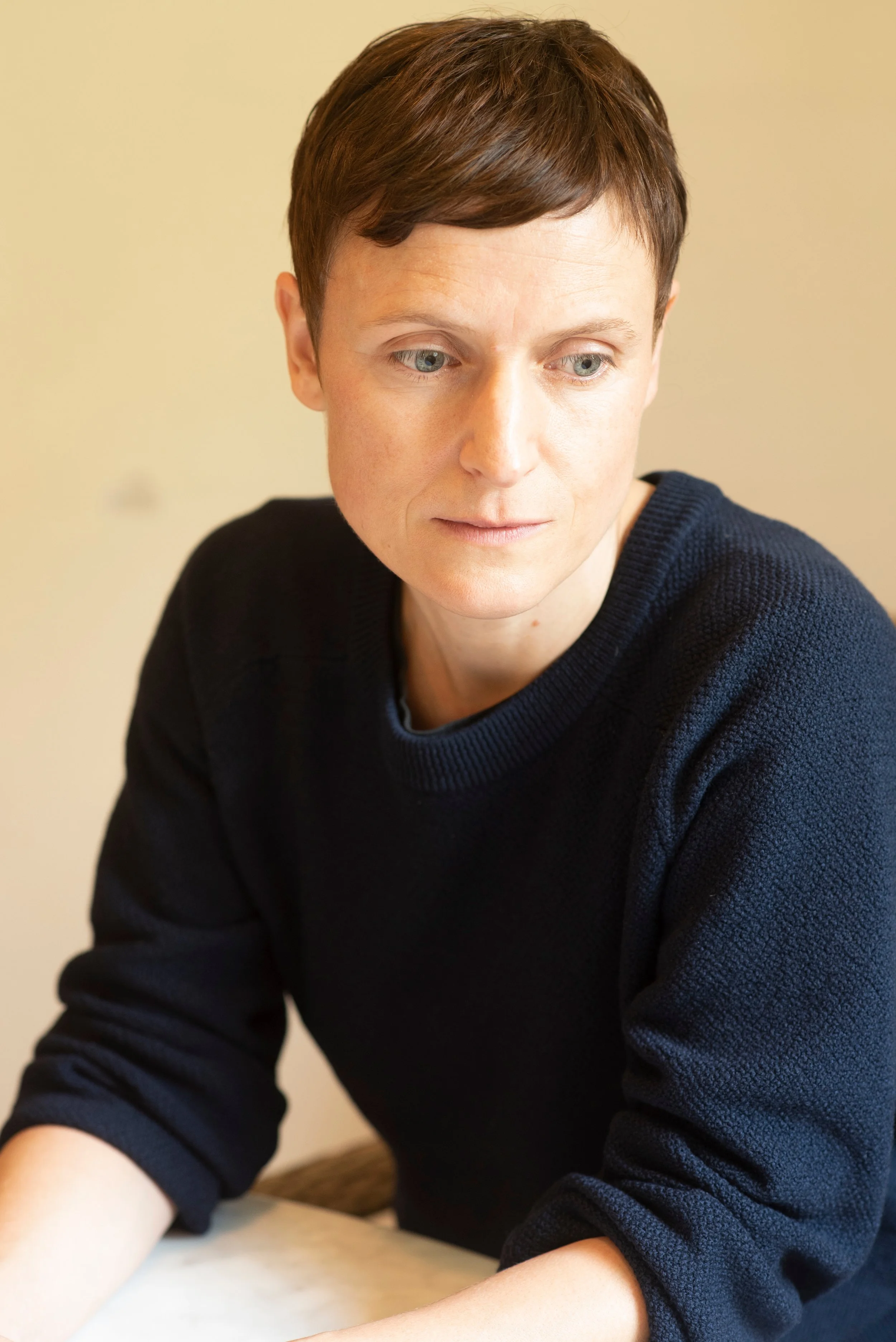
Portrait by Dmitri Kasterine
Christina Kral is a visual artist who lives and works in Frankfurt am Main, Germany.
Kral began her artistic career in 2008 with a residency at Eyebeam in New York. This was followed by residencies at Columbia University, BRIC Contemporary Art (Brooklyn), Guapamacátaro (Mexico), and Gasworks (London). Her work has been exhibited internationally, including at the Cafa Biennale (Beijing), the Mercosul Biennale (Porto Alegre), the Bauhaus Archive in Berlin, and the Ludwig Múzeum in Budapest. She has received grants and awards including a Pollock-Krasner Foundation Grant in 2022.
After a decade immersed in a participatory artistic practice she has made abstract painting her core work since 2019.
Artist Statement
I understand painting as a language I acquire through play, experimentation, misunderstanding and continuous practice. Typically, I start from something I want to test. The material becomes an active participant, offering resistance, possibilities and unexpected directions. I let previous decisions remain visible: traces, interruptions and changes of direction are part of the work. Painting, in this sense, is a performative practice, something that changes as I engage with it.
This approach developed out of a longer engagement with participatory and material-based work. Before turning to painting in 2019, I worked with found objects, fragments and assemblage, creating situations for encounter and participation. Painting let me carry that responsiveness into a more concentrated, sustained studio practice: a space in which things can remain unresolved and where an idea can shift through material, repetition and time.
The paintings vary considerably. Some are fluid and ephemeral (D-04, 2021), built from poured, brushed or airbrushed layers (Rosy Fingers, 2026); others are dense constructions that develop slowly through repeated intervention (K-Drama, 2025). Rather than a fixed visual signature, I want to keep a field of possibilities open. Unpredictability is central to this: it lets a work hold a situation open long enough for an alternative to emerge. Surrounded by systems that reward fixed positions, quick conclusions and clear categories, I want to work in the opposite direction, making room for ambiguity, change and the coexistence of different states.